Executive Summary and the Economics of Live Talent Buying
In the contemporary live music ecosystem, the talent buyer—alternatively designated as the venue booker or promoter—operates as a commercial broker representing the financial and reputational interests of a performance space. Following the structural disruptions of the post-pandemic era, independent clubs, theaters, and festivals face compressed operating margins, fluctuating patron attendance, and intensified competition from alternative entertainment sectors. Consequently, live music programming is governed by strict risk mitigation. When a talent buyer evaluates an artist submission, the primary objective is not artistic curation in a vacuum, but rather the verification of a reliable commercial product capable of generating ticket revenue, driving food and beverage spend, and retaining an audience inside the room.
Within this risk-averse operational framework, video documentation serves as the primary empirical evidence of an act's commercial and technical viability. While streaming audio metrics and social media follower counts provide baseline indicators of market awareness, audio files alone cannot substantiate whether a recording project can translate its studio sound into a compelling physical event. Talent buyers overwhelmingly prioritize authentic, unvarnished live performance footage over high-budget narrative music videos because the transaction fundamentally involves purchasing a live stage show. A well-executed live video simultaneously resolves multiple due-diligence questions: it verifies vocal and instrumental competence without studio manipulation, demonstrates stage presence and visual authority, confirms the exact touring configuration being offered, and provides visual proof of real-world audience engagement.
However, the efficacy of a video submission is heavily mediated by how it is captured, formatted, and delivered. Overwhelmed by dozens to hundreds of weekly inquiries, venue bookers enforce rigid screening heuristics that penalize technical friction. Submissions that rely on downloadable file attachments, buried links, distorted smartphone microphone audio, over-edited highlight montages, or mismatched aspect ratios are systematically filtered out before the musical content is ever evaluated. Understanding the precise intersection of booker workflow psychology, audio-visual production engineering, and enterprise booking software architecture is therefore essential for any performing act or management team seeking to secure live performance dates.
The Screening Funnel: Inbox Dynamics and Temporal Constraints
The structural preferences of venue bookers regarding video submissions are dictated by severe time scarcity and inbox saturation. At both grassroots sub-200-capacity rooms—where a single owner often manages booking alongside general venue operations—and multi-location club enterprises such as Brooklyn Bowl or AEG Presents venues, buyers process a continuous volume of unsolicited pitches alongside agent-represented holds. Empirical data from DIY touring operations indicates that cold email outreach to live music venues yields a baseline response rate of approximately 1% (1 in 100), with roughly 90% of confirmed bookings materializing only after systematic follow-up correspondence—frequently on the third follow-up spaced at one-week intervals. Conversely, targeted outreach that demonstrates specific research into a venue's programming calendar and sonic identity increases booking conversion probability by up to 40% over generic mass blasts. Furthermore, industry campaign data across more than 2,400 artist pitches demonstrates that acts maintaining an updated Electronic Press Kit (EPK) with current streaming telemetry and professional visual assets receive three times more buyer responses than those submitting incomplete or outdated materials.
Because buyers operate under intense cognitive load, the evaluation of an artist pitch follows a strict chronological triage. When a booker opens an inquiry, the immediate goal is to determine within 30 to 90 seconds who the artist is, what the project sounds like, whether the act will sell tickets in that specific market, and whether the musicians will operate professionally on the day of the show. Before clicking a video or audio link, buyers filter submissions by genre, home base, and local market history. As talent buyers and production managers at major promoters such as AEG Presents and Sonicbids emphasize, past show history in the specific target city—including room capacities played, night-of-the-week placement, verified ticket counts, and repeat bookings at respected venues—serves as the primary predictor of financial viability. Repeat plays at the same venue are weighted heavily because they signal that the act generated a profitable turnout and behaved professionally enough to be invited back.
Once an act passes the initial demographic and market-history filter, the buyer initiates media verification. At this stage, temporal tolerance drops sharply: a buyer may sample only the first 10 seconds of a streamed audio track to gauge sonic fit and production quality, and will typically decide whether to book an act within the first 60 to 120 seconds of watching a live performance tape. Consequently, the structural design of the email pitch and EPK must eliminate all navigational latency. Emails must remain under 5 to 10 sentences (roughly 50 to 100 words), featuring a highly informative subject line (specifying Artist Name, Target City, Requested Date, or Support Inquiry) and placing a single, direct link to the live performance video early in the body of the message.
| Evaluation Phase | Target Asset / Component | Booker Time Allocation | Primary Due-Diligence Objective | Critical Failure Modes Leading to Rejection |
|---|---|---|---|---|
| Phase 1: Inbox Triage | Email Subject Line & Opening 5–10 Sentences | 5–10 Seconds | Identify artist name, genre, home base, requested dates/routing, and local show package. | Generic mass blasts, missing target dates, overlong origin stories, or using the word "Urgent" in subject lines. |
| Phase 2: Rapid Skim | One-Sheet / Above-the-Fold EPK Fact Strip & Short Bio | 10–30 Seconds | Verify market history, draw/headcount metrics, social follower counts, and genre positioning. | First-person bios ("I/We"), unsubstantiated buzzwords ("epic", "raw energy"), or missing city/genre identifiers. |
| Phase 3: Sonic Triage | Embedded Streaming Audio Player (Strongest Track First) | 10–30 Seconds | Confirm studio recording quality and whether the musical style fits the venue's crowd. | Attaching MP3/WAV files directly to emails, forcing app downloads, or leading with a weak newest track over a proven strongest track. |
| Phase 4: Live Verification | Primary Live Performance Video Link (YouTube / Embedded) | 60–120 Seconds (of a 5–7 min video) | Assess live vocal/instrumental chops, stage presence, crowd reaction, and exact band configuration. | Submitting only narrative studio music videos, bedroom livestreams, empty-room clips, or heavily cut highlight montages. |
| Phase 5: Operational Audit | Full EPK, Tech Rider, Stage Plot & Input List | 90 Seconds Total | Ensure smooth day-of-show advancing, technical compatibility, and ready-to-use marketing assets. | Missing input lists, outdated tour calendars, broken links, or lack of downloadable hi-res landscape/portrait photos. |
Format Hierarchy: Live Performance Footage Versus Official Music Videos
A pervasive strategic error among independent musicians and emerging management teams is conflating the video requirements of record labels, sync licensing agents, and music journalists with those of live venue talent buyers. While all industry gatekeepers value visual polish, their functional objectives diverge fundamentally. Publicists, blog curators, and label A&R representatives evaluate official narrative music videos to assess an artist's broader aesthetic vision, storytelling capability, production budget, and multimedia shareability. For media outreach, including director credits, cinematographer (DP) details, styling notes, 16mm film specifications, and behind-the-scenes (BTS) folders provides journalists with a narrative hook for editorial coverage.
Conversely, for a venue booker or festival buyer, a polished narrative music video carries minimal diagnostic weight regarding live performance capability. Studio-synced music videos mask vocal pitch instability, instrumental timing flaws, and physical stage lethargy behind studio overdubs and cinematic editing. Because live performance is inherently risky, a talent buyer requires unvarnished proof of what occurs in a physical room when the band is amplified. Consequently, booking-focused EPKs and pitch emails must prioritize a dedicated live performance video above all other visual assets.
When evaluating a live performance video, talent buyers scrutinize four interconnected operational dimensions: musical execution, stage presence, audience engagement, and ensemble configuration accuracy. First, the recording must prove that the act can replicate or exceed the quality of its studio tracks in a live acoustic environment, with buyers specifically verifying clearly audible lead vocals and distinct instrumental separation to confirm the performers are not hiding behind pre-recorded studio playback tracks. Second, because audiences experience a concert as much with their eyes as with their ears, bookers assess whether performers project visible confidence and look as though they belong on a professional stage. Performers who stand frozen like statues, mumble into microphones, stare at the floor or ceiling, or apologize onstage signal amateurism that alienates paying patrons. Instead, buyers look for deliberate stagecraft, such as walking to the edge of the stage, initiating physical mirroring by clapping toward the crowd upon arrival to trigger reciprocal applause, maintaining direct eye contact—or simulating it by fixing gaze on the foreheads, eyebrows, or back wall just above the audience—and having non-singing band members sing along to lyrics to project unified conviction.
Third, a live video must depict the artist performing to actual people in a live venue rather than an empty room or a bedroom livestream. Talent buyers explicitly distinguish between a genuine live performance video filmed in a venue setting and a livestream or rehearsal clip, as seeing an engaged crowd reacting positively validates that the band can hold a room and drive bar retention. Fourth, the stage configuration visible in the video must match the exact package being pitched to the buyer. If an artist pitches a five-piece full-band arrangement for a 45-minute club set, submitting a solo acoustic video or a ten-piece studio collective creates immediate operational ambiguity regarding stage footprint, monitor mixes, and financial guarantees. Best-practice booking pitches explicitly confirm in writing that the linked video depicts the exact configuration offered for the requested date alongside the corresponding stage plot and input list.
Despite the primacy of live venue footage, secondary video formats retain strategic utility when deployed correctly within a comprehensive EPK. Seasoned talent buyers who have booked thousands of shows often welcome a paired submission consisting of one official music video and one live performance video. While the live clip secures the buyer's confidence in the stage show, the official music video demonstrates brand investment and provides the venue's marketing department with a polished promotional asset to share on social channels once the show is confirmed and tickets go on sale. Similarly, multi-camera live studio sessions—featuring professional lighting, haze, and synced studio-floor audio—or stripped-down acoustic sessions serve as effective bridge assets for newly formed projects that have just completed an EP and are transitioning from open mics and small rooms into formal venue pitching. If an emerging act possesses neither live concert footage nor a professional music video, industry practitioners suggest recording a concise 60-to-90-second direct-to-camera introduction detailing the stage show and past crowd responses as a temporary stopgap, while making the capture of two to three songs at an upcoming live gig an immediate operational priority.
| Video Asset Classification | Primary Target Gatekeeper | Core Diagnostic Value | Optimal Duration | Deployment Role in Booking Workflow |
|---|---|---|---|---|
| Live Concert Video (With Audience) | Venue Talent Buyers, Festival Bookers, Booking Agents | Verifies live vocal/instrumental chops, stage presence, crowd reaction, and exact band configuration. | 1 Full Song or 5–7 Minute Full Set | Primary pitch asset; placed early in email body and above the fold on the EPK. |
| Multi-Camera Live Studio Session | Venue Bookers, Club Promoters, DJ Talent Buyers | Proves technical proficiency, equipment familiarity (e.g., Pioneer CDJ-3000s), and live arrangement cohesion in a controlled environment. | 1 Full Track (3–5 Mins) or Full DJ Set | High-value supplement or primary substitute before major live crowd footage is captured. |
| Stripped-Down / Acoustic Session | Listening Rooms, House Concerts, Festival Buyers | Isolates raw vocal timbre, harmonic blend, and songwriting strength without heavy production. | 1 Full Song (3–4 Mins) | Secondary EPK video demonstrating dynamic range and adaptability to intimate rooms. |
| Official Narrative Music Video | Music Press/Blogs, Record Labels, Sync Agents, Venue Marketing Teams | Signals financial backing, visual identity, creative team pedigree, and promotional shareability. | Full Single Length (3–4 Mins) | Secondary EPK asset for bookers; used by venues post-booking to promote ticket sales. |
| Short-Form Vertical Video (9:16) | Social Algorithms (TikTok, Reels, Shorts) & Buyer Metric Audits | Drives organic fan discovery, viral velocity, and post-show social reach. | 3–8 Sec (Loops), 30–60 Sec (Highlights), up to 90 Sec (Reels) | Social proof infrastructure; slices of long-form sets used to build the follower metrics buyers audit. |
Technical Production Standards for Booking Video Submissions
Audio Architecture: Soundboard Feeds, Matrix Mixing, and Mobile Mic Limitations
While visual framing establishes stage context, audio fidelity is the single most decisive technical factor in a booking video. A video submission with cinematic 4K imagery but muddy, clipping, or indistinct audio will be rejected by talent buyers because it fails to verify musical competence. Conversely, a straightforward phone or two-camera video paired with crisp, balanced audio routinely secures bookings.
A common technical failure in DIY live recordings is relying exclusively on the internal microphone of a smartphone positioned near the stage. Acoustic engineering discussions and live sound measurements demonstrate that built-in cell phone microphones are uncalibrated for high sound pressure levels (SPL), exhibiting erratic frequency weighting and severe dynamic compression or clipping when exposed to concert volumes of 92 to 110 dB. Furthermore, most modern smartphones utilize a default firmware setting that links audio microphone gain directly to optical or digital camera zoom; when a videographer zooms in on a performer from across a room, the phone artificially boosts microphone sensitivity, causing harsh distortion unless the mic-zoom function is manually disabled in advanced recording settings. Even in acoustic or solo instrumental contexts, camera placement heavily skews frequency balance—for instance, placing a mobile mic on the bass side of a piano or stage overpowers treble frequencies and vocal clarity unless positioned at an optimal distance of at least 1.5 meters in an echo-controlled space.
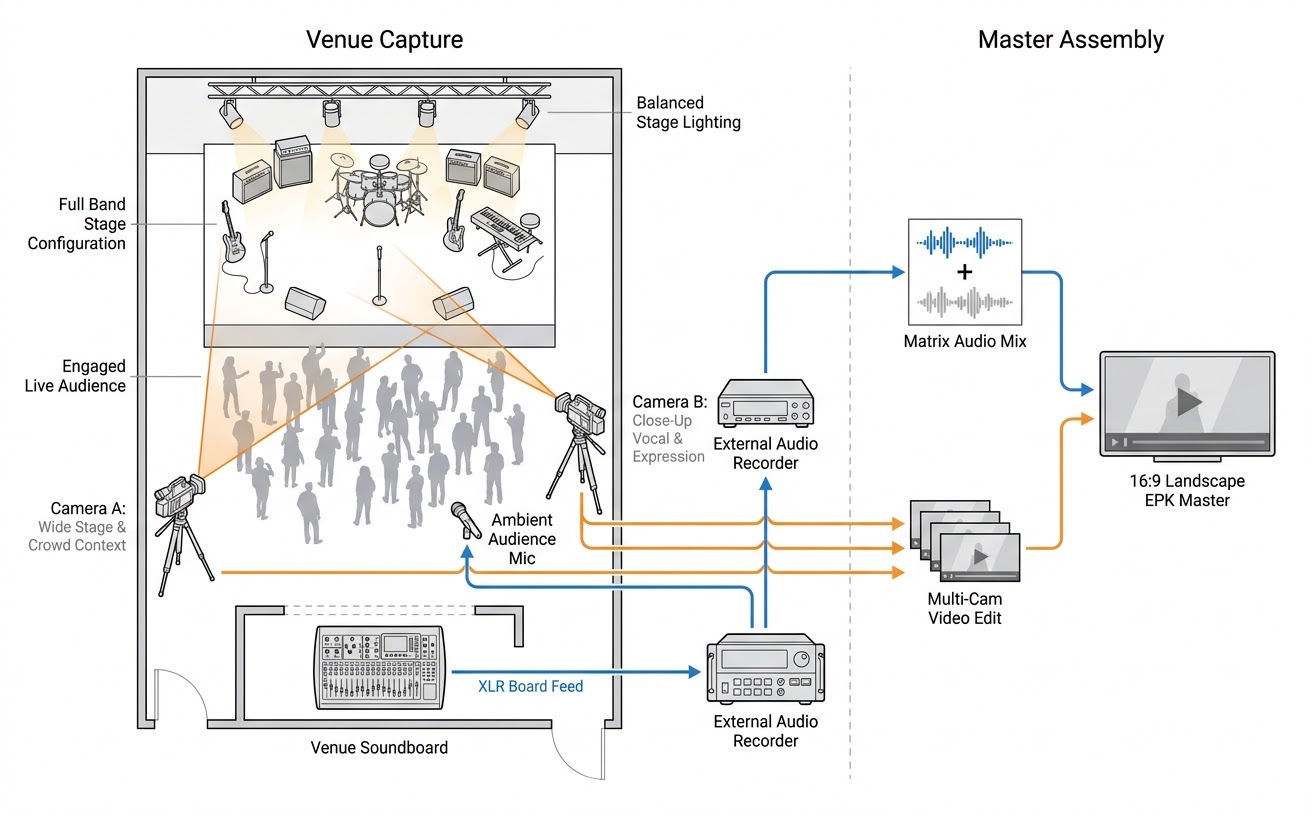
From an operational workflow perspective, capturing clean live audio requires arriving 30 to 45 minutes prior to doors to coordinate with the house sound engineer, running a 30-second test recording during soundcheck at full performance volume, and calibrating input gain so normal vocal and instrumental passages register between -12\\text{ dB} and -6\\text{ dB}, leaving sufficient headroom for loud peaks without digital clipping. In post-production, applying a high-pass filter to eliminate low-frequency stage rumble, attenuating muddiness in the 200\\text{--}350\\text{ Hz} range, and applying light compression and de-essing ensures that lead vocals cut cleanly through the mix when a talent buyer listens on laptop speakers or office monitors.
Cinematography, Multi-Camera Framing, and Editorial Integrity
On the visual side, talent buyers do not require extravagant cinema budgets; a steady, well-framed smartphone recording from a strong gig is vastly preferred over having no live footage, provided it shows the band performing to a real crowd with clear audio. However, when upgrading from grassroots bar gigs to competitive support slots, theaters, and festivals, transitioning from a single static phone to a two-camera or multi-camera setup yields a substantial return on perception.
In a standard two-camera EPK shoot, Camera A is locked on a tripod in a wide or medium framing that establishes the full physical body of the performers, the complete band configuration on stage, and the immediate audience context. Camera B is positioned for tight close-ups that capture facial expressions, vocal delivery, and instrumental dexterity. Switching between two or more angles breaks the visual monotony of a single static shot while proving that the act commands the physical stage. Technical execution requires setting cameras to continuous face-tracking autofocus (as manual focus in dark clubs from 30 feet away frequently drifts), locking exposure to prevent brightness pumping, and manually calibrating white balance during soundcheck so stage lighting renders natural skin tones. Furthermore, performers performing in "in-the-round" or unconventional venue layouts must maintain eye contact within standard stage parameters so they do not appear disoriented or nervous on tape where the booker cannot see the surrounding seating geometry. If venue lighting is excessively dark, deploying a small portable LED light or enhancing post-production shadow exposure ensures the buyer can clearly see the performers and crowd details.
Crucially, editorial pacing must prioritize authenticity over flashy cutting. A major consensus among club and festival bookers is a strong aversion to highlight montages or heavily snipped clips. When an artist submits a 90-second sizzle reel composed of three-second rapid-fire cuts set to studio audio, buyers immediately suspect the act is trimming out weak playing, poor crowd reactions, or an inability to sustain energy across a full song. Instead, bookers prefer seeing a complete, continuous performance—either one full representative song (3 to 4 minutes) or a tight, unedited 5-to-7-minute full-band live set. Editing should be limited to clean multi-camera angle switching—cutting to close-ups during key vocal hooks, solos, or punchlines, and wide shots for band interaction and crowd response—without over-cutting.
Aspect Ratio Bifurcation: Landscape Evaluation Versus Vertical Discovery
The rise of mobile-first social media has created a structural tension in video orientation standards within the music industry. Talent buyers and artist development strategists now navigate a strict functional division between horizontal (16:9 landscape) assets used for direct B2B booking evaluation and vertical (9:16 portrait) assets used for B2C fan acquisition and algorithmic social proof.
For the primary live performance video embedded in an EPK or linked in a booking pitch email, 16:9 landscape orientation remains the mandatory professional standard. Talent buyers review pitches primarily on desktop workstations or tablet dashboards using venue management software and mail clients. A horizontal frame naturally accommodates the horizontal geometry of a stage, allowing the buyer to verify a full four- or five-piece band configuration and observe wide-angle audience interaction simultaneously. Traditional venue bookers—particularly in comedy, rock, and club circuits—explicitly reject vertical video for primary performance evaluation, viewing portrait-oriented submission tapes or EPKs built from vertical video screenshots as indicators of an amateur act that does not understand professional industry presentation.
However, dismissing vertical video entirely is a strategic miscalculation in the 2026 live music market. Short-form vertical video—deployed across TikTok, Instagram Reels (up to 90 seconds), YouTube Shorts, and 3-to-8-second visual loops—is the dominant mechanism by which fans discover music. Because talent buyers openly acknowledge that social media follower counts and engagement velocity are among the only verifiable metrics available to estimate how many tickets an emerging artist will sell in a new market, an artist's vertical video ecosystem directly influences booking decisions.
Furthermore, in high-growth live sectors such as the Gen Z tribute band boom and modern electronic/DJ club circuits, vertical video has evolved from a marketing afterthought into core competitive infrastructure. Forward-thinking talent buyers and booking agencies actively evaluate whether an act designs its live show with vertical-video-friendly lighting, designated photo moments, and reel-ready set moments that incentivize concertgoers to film and share vertical clips during the show, thereby expanding organic social reach for the venue itself. Sophisticated touring acts employ a dual-capture workflow: filming a multi-camera 4K horizontal master (hosted on YouTube) to serve as a digital business card for club bookers, while utilizing "Hook-Point" editing strategies and automated cropping utilities (such as CropCam) to slice those same long-form live sessions into vertical micro-moments for daily social syndication. Within 48 hours of completing a gig, delivering a 30-to-60-second vertical highlight video tagged with the venue and promoter maximizes algorithmic engagement and cements relationships for repeat bookings.
In addition to video aspect ratios, venue bookers enforce strict orientation requirements for static promotional imagery within the EPK. Because venue marketing teams and festival promoters utilize pre-built graphic templates for print posters, website headers, and social feeds, an EPK must provide downloadable photo assets in both landscape (horizontal) and portrait (vertical) orientations, alongside square-croppable options, monochrome (black-and-white) variants, and a transparent PNG band logo.
| Visual Asset Type | Required Orientation / Aspect Ratio | Resolution & Technical Spec | Hosting / Delivery Mechanism | Functional Purpose for Venue & Booker |
|---|---|---|---|---|
| Primary EPK Live Performance Video | Landscape / Horizontal (16:9) | 1080p HD to 4K @ 30/60fps; Matrix/Soundboard Audio (-12 to -6 dB peak) | YouTube (Public or Unlisted) Embedded Above the Fold | Direct B2B stage verification: confirms live chops, full-band stage configuration, and crowd draw. |
| Unreleased Official Music Video | Landscape / Horizontal (16:9) | High-Bitrate HD/4K (including 16mm/Cinema transfers) with Full Credits | Password-Protected Vimeo Link or Unlisted YouTube Embed | Demonstrates brand polish to labels, press, and sync agents; shared by venues post-booking to drive ticket sales. |
| Short-Form Live Highlight / Hook Clips | Vertical / Portrait (9:16) | 1080x1920 Vertical Capture; 3–8s (Canvas), 30–60s (Post-Show), up to 90s (Reels) | Native upload to TikTok, Instagram Reels, YouTube Shorts (Linked via EPK Social Stats) | B2C algorithmic discovery; builds the follower and engagement metrics talent buyers audit to estimate draw. |
| EPK Promotional Press Photos (Print) | Minimum 1x Landscape AND 1x Portrait | High-Resolution 300 DPI (Colour \+ Monochrome/B&W variants) | Direct Download on EPK \+ Dropbox Asset Folder (File size & pixel dimensions listed) | Allows promoters and print media to drop artist imagery directly into venue poster templates and magazine layouts. |
| EPK Web & Banner Photos | Landscape, Portrait, and Square-Croppable | Web-Ready Low-Res 72 DPI (Minimum 600 pixels wide) \+ Transparent PNG Logo | Direct One-Click Download on EPK Page (No login or email request required) | Used for venue website event listings, digital ticketing banners, and social media show announcements. |
Delivery Architecture, EPK Placement, and Booking Software Ecosystems
Even a technically flawless live performance video will fail to secure a date if its delivery mechanism introduces friction into the talent buyer's workflow. Across the global live music industry, venue bookers maintain an absolute, non-negotiable prohibition against email attachments and downloadable media files. Sending raw MP4 video files, MP3/WAV audio attachments, or multi-megabyte PDF press kits in an unsolicited email triggers corporate spam filters, consumes inbox storage, poses cybersecurity risks, and forces waiting periods on mobile and desktop devices. All audio and video assets must be delivered exclusively via instant-streaming web links.
Within the pitch email itself, click minimization is paramount. Veteran bookers such as Joel Eckels (The Hotel Cafe, Los Angeles) note that every additional click or external redirect increases buyer impatience; performance videos that can be previewed directly inside the mail client or launched via a single, unmistakable YouTube link early in the email body achieve the highest view-through rates. Conversely, sending a generic Linktree URL in place of a structured pitch is widely rejected by promoters, as Linktree presents a contextless list of buttons that forces the buyer to hunt for basic biographical, geographical, and visual verification. If an artist uses a link aggregator on social media, it should function strictly as a traffic splitter with a dedicated button routing industry contacts to a formal EPK page.
When a talent buyer clicks through to an artist's dedicated EPK webpage—hosted via specialized music platforms such as Gigwell (Artist Essentials), Bandzoogle, EncoreSpot, Sonicbids, or a custom artist domain—the visual layout dictates whether the buyer stays beyond the initial 10-second scan. Modern information architecture for booking EPKs requires a strict above-the-fold hierarchy that immediately displays a striking hero photo, the artist name, a one-line positioning statement specifying genre, sonic reference points, and home city, and a concise fact strip detailing release status and draw highlights. Directly alongside or beneath this identity header, both the primary live performance video (embedded via YouTube or Vimeo) and the streaming audio player (leading with the artist's absolute strongest track rather than merely the newest release) must be playable inline above the fold without scrolling or navigating away from the EPK page.
To support rapid evaluation and post-booking marketing, the EPK should pair these embedded players with tiered biographical copy. Because buyers skim in under 30 seconds while venue marketers copy and paste text directly into ticketing listings, the EPK should feature a concise short bio (50 to 75 words, or one paragraph of three to five sentences) written strictly in the third person, focusing on sound comparisons and notable show history rather than band origin stories. A longer third-person bio (200 to 300 words) and a one-sentence elevator pitch should also be accessible for festival programs and press features, written cleanly so they can be published on a venue's website unedited. Below the media and biographical sections, the EPK must house a verifiable gig calendar and market history, social media links with live follower telemetry, downloadable press photos (with file sizes and pixel dimensions clearly labeled), and a direct link to an accurate technical rider, stage plot, and input list. For cover-focused or tribute acts in 2026, clearly documenting repertoire and licensing compliance is also increasingly scrutinized by venue bookers wary of unlicensed content liabilities.
Crucially, the modern EPK no longer exists in isolation; it interfaces directly with enterprise venue management and talent-buying software. On the venue side, talent buyers manage hold calendars, financial deal cards, offer sheets, artist advancing, and post-show settlements inside centralized cloud platforms—most notably Prism (widely regarded by multi-venue buyers as the industry gold standard for calendar management), Gigwell Talent Buyer Pro, Opendate, and VenuePilot. Once a booking contract is executed in systems like Gigwell Talent Buyer Pro, automated sequential workflows immediately trigger cross-departmental tasks: the venue's marketing team pulls the EPK's embedded live video and hi-res photos from a Central Talent Hub to build ticketing pages, while the production manager extracts the stage plot and input list for soundcheck advancing. Artists who utilize cloud-based EPKs with built-in booking request forms and real-time availability calendars allow talent buyers to check routing open dates at a glance and issue formal inquiries directly into the artist's CRM without back-and-forth email delays.
Strategic Conclusions and Execution Protocol
Maximizing booking conversion across club, theater, and festival circuits requires performing artists, managers, and booking representatives to treat video documentation as a technical risk-reduction asset rather than an abstract creative statement. In practice, this begins by ceasing reliance on narrative studio music videos, bedroom livestreams, or raw smartphone microphone clips as primary booking pitches. Instead, acts should allocate production budget to capture a two-camera live performance at a well-attended venue—or a staged live-room showcase with an invited audience—depicting the exact touring configuration being pitched. By recording a direct XLR feed from the mixing console calibrated at -12\\te\[span_103\](start_span)\[span_103\](end_span)\[span_105\](start_span)\[span_105\](end_span)xt{ dB} to -6\\text{ dB} peak headroom and blending it with an ambient room microphone into a matrix mix, performers preserve both vocal clarity and authentic crowd reaction. Delivering this capture as a single full representative song (3 to 4 minutes) or a continuous 5-to-7-minute live set avoids the suspicion triggered by rapid-fire highlight montages.
Simultaneously, acts must enforce strict aspect ratio discipline across B2B and B2C channels. While the primary EPK performance video must be delivered in 16:9 horizontal landscape format on YouTube to ensure instant inline desktop playback for talent buyers, the underlying 4K master footage should be systematically sliced into 9:16 vertical micro-moments (30 to 90 seconds) for TikTok, Instagram Reels, and YouTube Shorts. This dual pipeline satisfies the desktop evaluation standards of venue bookers while building the social follower and engagement telemetry that those same buyers audit to forecast ticket draw. Static press photos must similarly be supplied in both landscape and portrait orientations at 300 DPI and 72 DPI alongside a transparent PNG logo to streamline venue poster and web production.
Finally, technical video excellence must be paired with frictionless outreach execution and post-show relationship management. Outreach should be initiated 6 to 12 months in advance for desirable paying venues using intelligence databases such as Indie on the Move, Gigwell TourIQ, or Booking-Agent.io. Pitch emails should remain within 5 to 10 sentences under a clear subject line specifying the artist, city, and target date, placing the direct YouTube live video link and EPK URL in the opening lines while explicitly confirming the ensemble configuration and set length. For emerging or regional acts drawing 10 to 50 patrons, transparent draw reporting combined with pre-packaging a complete bill alongside one to three established local bands (copied directly on the pitch email) eliminates the talent buyer's heaviest administrative burden. Executing a disciplined weekly follow-up sequence across three touches captures the 90% of bookings that close after initial outreach, while delivering a 30-to-60-second vertical highlight clip within 48 hours post-show—accompanied by a settlement note documenting ticket count and bar spend—cements the operational credibility that drives repeat venue residencies and long-term touring growth.
Works cited
1\. Club Booking, Opening Slots, Deal Breakdowns with Brooklyn Bowl, https\://podcasts.musixmatch.com/podcast/the-new-music-business-with-ari-herstand-01gv03qx000094ej6zhdmch4y6/episode/club-booking-opening-slots-deal-breakdowns-with-brooklyn-01hjz7abr0w71n49nd313an9jc 2\. Music Industry Glossary - Gen Admission, https\://www\.genadmission.org/glossary 3\. How to Create an EPK in 2026: The Complete Guide for Musicians, https\://www\.encorespot.com/blog/how-to-create-epk 4\. How to Get Venues' and Promoters' Attention Every Time, https\://blog.sonicbids.com/how-to-get-venue-and-promoters-attention-every-time 5\. How to Get Gigs as a Musician (and Keep Getting More) - Noiseyard, https\://noiseyard.com/en/blog-for-musicians/how-to-get-gigs-as-a-musician 6\. Hotel & Hospitality Video Production in Qatar: What Every Property, https\://eyefocusmedia.com/en/blog/hotel-hospitality-video-production-qatar 7\. What Is an EPK and Does Your Band Actually Need One?, https\://stageportal.gg/blog/what-is-an-epk-and-does-your-band-actually-need-one/ 8\. The Ultimate Guide to Video for Musicians in 2026, https\://diymusician.cdbaby.com/video/video-for-musicians-in-2025/ 9\. I am a Talent Buyer for multiple venues. Ask Me Anything! - Reddit, https\://www\.reddit.com/r/musicindustry/comments/17plz6t/i_am_a_talent_buyer_for_multiple_venues_ask_me/ 10\. How to Promote Your Recorded DJ Set in 2026 - Book a DJ Studio, https\://bookadjstudio.com/how-to-promote-your-recorded-dj-set-in-2026-the-ultimate-artist-growth-guide/ 11\. 5 Point Artist Booking Email Template - SmartistU, https\://smartistu.com/5-point-artist-booking-email-template 12\. EPK Mistakes That Get Artists Ignored - Power Grind Radio, https\://powergrindradio.net/2026/10/13/epk-mistakes-that-get-artists-ignored/ 13\. How to Create an EPK and Exactly What to Put in It - Sonicbids Blog, https\://blog.sonicbids.com/how-to-make-an-epk 14\. EPKs 101: What every artist needs in their electronic press kit, https\://www\.reelcrafter.com/blog/epks-101-what-every-artist-needs-in-their-electronic-press-kits 15\. EPK Guide: How to Build an Electronic Press Kit for Music Promotion, https\://musicvideohype.com/glossary/glossary-epk/ 16\. 9 Ways to Impress a Venue Talent Buyer, Even if You Can't Pack the, https\://blog.sonicbids.com/9-ways-to-convince-a-venue-to-book-you-if-you-cant-pack-the-house 17\. What are some requirements for a stand-up video I'd send ... - Reddit, https\://www\.reddit.com/r/Standup/comments/57dcn5/what_are_some_requirements_for_a_standup_video_id/ 18\. For quality sounds,live band,video and live streaming - Facebook, https\://www\.facebook.com/kevo.kevo.196650/posts/for-quality-soundslive-bandvideo-and-live-streaming/122265923300230007/ 19\. Gigwell's Artist Essentials - Gig Booking Software, https\://www\.gigwell.com/artist-essentials 20\. How to Book Shows Without a Booking Agent in 2026 - Playlist Supply, https\://ns1.playlistsupply.com/blog/book-shows-without-booking-agent-2026/ 21\. How to get more gigs/venues to respond to emails? : r/musicians, https\://www\.reddit.com/r/musicians/comments/1js7jqa/how_to_get_more_gigsvenues_to_respond_to_emails/ 22\. How to Book a Gig: A Step-by-Step Guide for Artists, https\://www\.anyonecanbookagig.com/how-to-book-a-gig/ 23\. The 2026 Musician EPK Checklist: What Booking Agents Actually, https\://aboutmysound.com/blog-posts/the-2026-musician-epk-checklist-what-booking-agents-actually-want-to-see 24\. Independently music promotion secrets for 2025, https\://blog.matchfy.io/how-to-promote-your-music-independently-in-2025-the-ultimate-guide/ 25\. EPK Examples: 3 Full Press Kits You Can Copy - Orphiq, https\://orphiq.com/resources/epk-examples-gallery 26\. Pitching to perform at a venue, https\://www\.livetoolkit.com.au/guide/pitching-to-perform 27\. How to Send a Killer Email to Anyone in the Music Industry, https\://blog.sonicbids.com/how-to-send-a-killer-email-to-anyone-in-the-music-industry 28\. Ask a Publicist: What Goes Into a Press Kit? - Sonicbids Blog, https\://blog.sonicbids.com/ask-a-publicist-what-goes-into-a-press-kit 29\. How to Approach Creating a Music Video on a Small Budget, https\://blog.sonicbids.com/how-to-approach-creating-a-music-video-on-a-small-budget 30\. Here are some tips and tricks I learned while touring the country, https\://www\.indieonthemove.com/blog/2016/5/here-are-some-tips-and-tricks-i-learned-while-touring-the-country-diy-as-a-singer-songwriterduo 31\. 6 Stage Hacks to Engage a Crowd - Sonicbids Blog, https\://blog.sonicbids.com/6-stage-hacks-to-engage-a-crowd 32\. How to Command the Room's Attention at Your Next Gig, https\://blog.sonicbids.com/how-to-command-the-rooms-attention-at-your-next-gig 33\. AMA: I am Chris "Seth" Jackson. Ask me anything about booking, https\://www\.reddit.com/r/bandmembers/comments/26m8qg/ama_i_am_chris_seth_jackson_ask_me_anything_about/ 34\. Without an agent, booking a tour can be challenging. So we asked, https\://www\.facebook.com/bandzoogle/posts/without-an-agent-booking-a-tour-can-be-challenging-so-we-asked-kyle-weber-from-i/10156286786423833/ 35\. The Indie Musician's Guide to Electronic Press Kits (EPKs), https\://diymusician.cdbaby.com/music-promotion/electronic-press-kits-epks/ 36\. Blog - Making It with Chris G., http\://www\.makingitwithchrisg.com/blog 37\. How to create a professional EPK? A practical guide for musicians, https\://www\.crave-digital.eu/en/news-en/how-to-create-a-professional-epk-a-practical-guide-for-musicians 38\. How to Create an EPK that Actually Books Gigs - Gigwell, https\://www\.gigwell.com/blog/how-to-create-an-epk 39\. Our "Full Artist Launch Pack" is designed for new or ... - Facebook, https\://www\.facebook.com/groups/SASForum/posts/29081929264828043/ 40\. Music Videography in Manchester - Dead Basic Studios, https\://deadbasicstudios.com/home/videography/ 41\. EP recorded. what now? : r/musicindustry - Reddit, https\://www\.reddit.com/r/musicindustry/comments/1tmogcm/ep_recorded_what_now/ 42\. Photography Services Conches, Genève | FilmGeneva, https\://filmgeneva.com/photography-services-conches-geneva 43\. Wanna see what goes into making a live music video? Over this, https\://www\.facebook.com/monokihq/posts/wanna-see-what-goes-into-making-a-live-music-video-over-this-week-were-gonna-bre/616423727215167/ 44\. How to Film Stand Up Comedy, https\://comedyhouston.com/how-to-film-stand-up-comedy/ 45\. Are decible meter apps accurate? : r/livesound - Reddit, https\://www\.reddit.com/r/livesound/comments/16x5kf0/are_decible_meter_apps_accurate/ 46\. Tips on creating the best recording for ABRSM Performance Grade, https\://mypianoteacher.net/about-exams/tips-on-submitting-the-best-recording-for-abrsm-performance-grade-exams/ 47\. How to Start a Rap Career With No Money (Zero-Budget Blueprint), https\://beatstorapon.com/blog/how-to-start-a-rap-career-with-no-money-zero-budget-blueprint/ 48\. 7 Things That Separate Amateur Bands From Professional Bands, https\://blog.sonicbids.com/7-things-that-separate-amateur-bands-from-professional-bands 49\. Production Attic Portfolio, https\://www\.productionattic.com/portfolio/ 50\. Why Gen Z Is Quietly Powering the Tribute Band Boom, https\://mztributebands.com/gen-z-tribute-band-boom-2026 51\. How to Build an EPK for a Cover-Focused Artist - Globex Music, https\://globexmusic.com/how-to-build-an-epk-for-a-cover-focused-artist/ 52\. Artist Booking Software for Agencies Compared: Gigwell vs Stagent, https\://www\.gigwell.com/blog/gigwell-vs-stagent 53\. Gigwell vs Prism: Which Booking Software is Best for Venues in 2025?, https\://www\.gigwell.com/blog/gigwell-vs-prism 54\. The Ultimate Guide to Finding & Booking Hip-Hop / Trap / R&B Gigs, https\://beatstorapon.com/blog/the-ultimate-guide-to-finding-booking-hip-hop-trap-rb-gigs-in-2025/ 55\. Digital Strategy for Musicians New to Social Media | The MU, https\://musiciansunion.org.uk/news/digital-strategy-for-musicians-new-to-social-media 56\. How to Leverage Social Media as a Musician | CodaBow, https\://blog.codabow.com/news/musician-social-media/ 57\. Revolutionizing Video Editing for Musicians: The Story Behind, https\://medium.com/@baekjster20/revolutionizing-video-editing-for-musicians-the-story-behind-cropcam-dc23b6ee9c5a 58\. Building your EPK: Electronic Press Kit - National Music Academy, https\://www\.nationalmusicacademy.com.au/post/building-your-epk-electronic-press-kit 59\. How to Build an EPK with Bandzoogle - FULL WALKTHROUGH, https\://www\.youtube.com/watch?v=Lewoytq2jVo 60\. Introducing the Artist Essentials Software - Gigwell, https\://www\.gigwell.com/blog/introducing-artist-essentials-software 61\. FAQ: Talent Buyer Pro for Venues & Promoters - Gigwell, https\://www\.gigwell.com/blog/talent-buyer-everything-venues-promoters-need-to-know 62\. What is an EPK? And why do you need one? - Indie on the Move, https\://www\.indieonthemove.com/blog/2023/5/what-is-an-epk-and-why-do-you-need-one 63\. r/Austin on Reddit: Venues book bands that can pull audiences. So, https\://www\.reddit.com/r/Austin/comments/1j7rbtm/venues_book_bands_that_can_pull_audiences_so_how/ 64\. How to Become a Gig-Booking Guru - Sonicbids Blog, https\://blog.sonicbids.com/how-to-become-a-gig-booking-guru 65\. How to Get Selected for a Residency at the Original Mother's, https\://blog.sonicbids.com/how-to-get-selected-for-a-residency-at-the-original-mothers-chicago-last-chance-to-apply